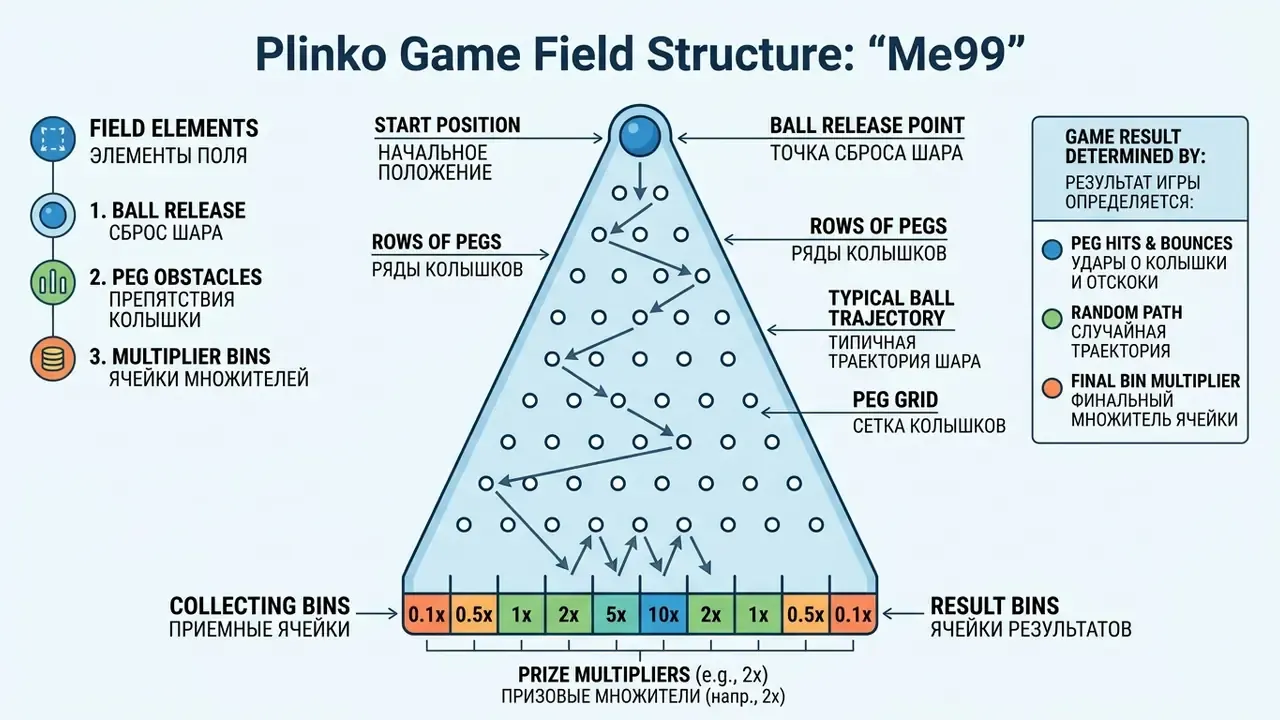
- Central pockets hold the largest number of possible paths. On a 16 row board, the chance of a central landing is C(16,8)/2¹⁶ = 12,870 / 65,536 ≈ 19.6%. That is exactly why the coefficients there are minimal, 0.2× to 0.5× on high risk.
- Edge pockets (max win) are reached by exactly one path: all 16 deflections must go the same way. The probability equals (0.5)¹⁶ = 1/65,536 ≈ 0.0015%. That extreme rarity is what funds the 555× or 1,000× multipliers.
- Multipliers do not change the physics. The payout table simply assigns a coefficient to each pocket, so the probability of a given multiplier equals the probability of the pocket holding it.
A classic example from the TV version. The The Price Is Right board had 13 peg rows and 9 chambers at the bottom, so the "clean" Pascal row (1, 12, 66, 220, 495, 792, 924, 792, 495, 220, 66, 12, 1) needs adjusting for side wall bounces: 12 is added to 66, and 1 to 220. After folding, the path distribution becomes 78 ways into the $100 chambers, 221 into the $500 chambers, 495 into the $1,000 chambers, 792 into the $10 chambers and 924 into the central $5,000/$10,000 chamber (dropping from the centre slot). As probabilities: 0.019 / 0.054 / 0.121 / 0.193 / 0.226 / 0.193 / 0.121 / 0.054 / 0.019.
Expected value follows easily. With a $10,000 centre chamber, the expected payout is roughly $2,555.32 per chip, so $12,766.60 across all five, against an advertised "up to $50,000". Since a contestant receives one chip guaranteed and four with probability 0.5, the real expectation falls to about $7,665.97. A neat demonstration of one principle: the advertised maximum and the expected value are different numbers. Online Plinko runs on the same logic.