Aviator by Spribe: Crash Game Mechanics, RTP, Demo Play and Strategy, an Evidence-Based Australian Guide

Last updated: February 2026 · Prepared by: the iGaming research desk (see our iGaming research and casino analysis hub) · Reading time: roughly 28 minutes

Responsible gambling notice. This article is educational and analytical. It is not gambling advice, financial advice or an inducement to gamble. Gambling involves a real risk of losing money, and no system described below changes that. Online casino-style games, including crash games such as Aviator, cannot lawfully be offered to Australian residents under the Interactive Gambling Act 2001. If gambling is causing you harm, contact the National Gambling Helpline on 1800 858 858 (24/7) or register with BetStop, the National Self-Exclusion Register.
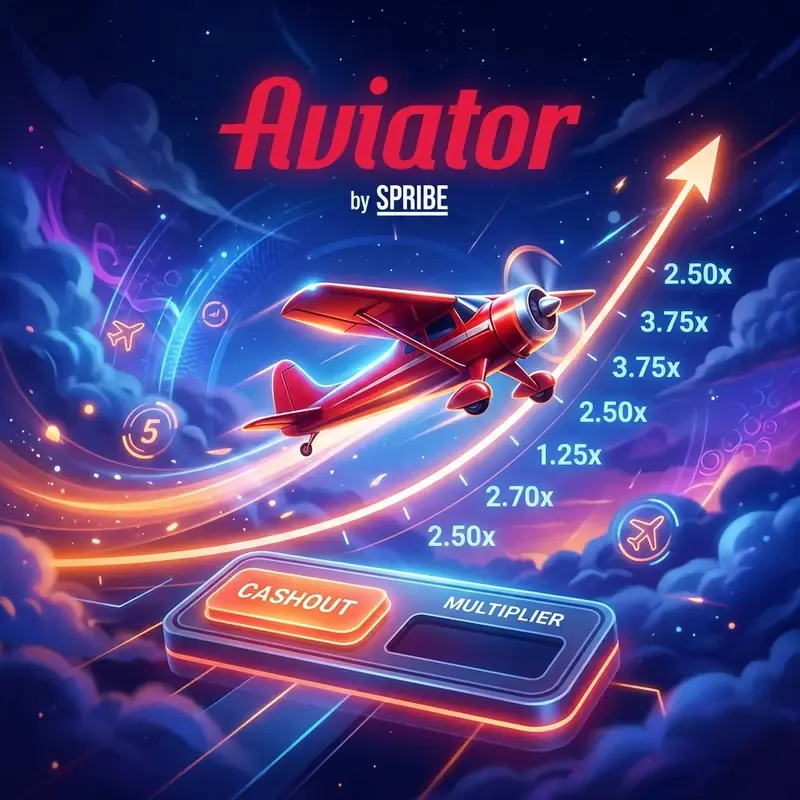
Provider

Spribe

RTP

97%

Volatility

High

Min bet

$0.10

Max win

10,000x

Aviator by Spribe Crash Game Mechanics
Key takeaways. - Aviator is a

Key takeaways

  • Aviator is a real-time multiplayer crash game released by Georgian studio Spribe in 2019. A multiplier climbs from 1.00x until a randomly predetermined crash point. You must cash out before the plane disappears, or the stake is gone.
  • Spribe publishes an RTP of 97% (a house edge of about 3.00%) and describes the game as high volatility with provably fair round generation.
  • The standard maximum multiplier is 10,000x, although Spribe's own marketing has also referenced a maximum win of 100,000x, and some operators advertise figures as high as 5,000,000x. Cash payout ceilings are set by each site, not by the game.
  • As of October 2025, Spribe's games, Aviator included, were not available in the United Kingdom. The studio hosts its games on its own servers and did not hold the additional game host licence required alongside its remote gambling software licence.
  • No strategy guarantees a win. Rounds are independent and the return-to-player figure sits below 100%, so expected value stays negative regardless of when you cash out. Strategies alter variance, not expectation.
  • Aviator demo (free play) is useful for learning the interface. Australian research on simulated gambling, though, shows that practice in non-monetary environments can normalise risky behaviour rather than protect against it.
Who this guide is for, and

Who this guide is for, and who should skip it

Search results for this game are dominated by two extremes: glossy affiliate pages promising systems, and forum threads full of anger about withdrawals. Neither helps much. This guide sits in between, and it is written for three kinds of reader.

Read it if you want the mechanics explained plainly. You have seen a red curve and a small plane in an ad, you understand roughly that people cash out for multipliers, and you want to know what actually determines the result. Sections 3 to 6 cover the round structure, the interface and the maths.

Read it if you are checking a brand before you deposit. Section 13 sets out the contract clauses that decide whether a bonus is worth anything to a crash-game player: wagering multipliers, expiry windows, maximum bet caps while a bonus is live, and whether crash titles count toward turnover at all. Many exclude them entirely. That single clause can make a 500% headline offer worthless.

Read it if you are worried about your own play, or someone else's. Sections 6, 8 and 11.5 summarise the Australian research on illusion of control, harm rates among online gamblers, and the tools that actually work.

Skip it if you are looking for a predictor, a hack or a signal group. There isn't one. Section 12.3 explains why, and what those downloads really do to your phone. Skip it too if you expect a ranking of "the best Aviator casino for Australians". Casino-style play cannot lawfully be offered here, so any such list would be misleading by construction.

1. Aviator at a glance: technical specifications

Crash titles live and die on transparency, so it helps to start with the published numbers before touching any of the strategy talk that dominates search results.

Technical specifications of Aviator

ParameterValue
DeveloperSpribe (founded 2018, Tbilisi)
Release date2019
Game typeCrash / instant win, real-time multiplayer
Return to player (RTP)97% (house edge about 3.00%)
VolatilityMedium-high to high (no numeric volatility class published)
Minimum betFrom about AUD $0.10 / ₦10 (set by each operator)
Maximum betAround $100 / ₦500,000 (set by each operator)
Maximum multiplier10,000x standard; provider materials have also cited up to 100,000x, and some sites advertise 5,000,000x (unverified)
Bets per roundUp to two simultaneous bets
Cash outManual or automatic (Auto Cash Out)
Fairness technologyProvably fair, with an RNG built from cryptographic hashes contributed by the server and players
Demo modeYes, a virtual-balance Aviator demo published by Spribe
Betting windowShort, often around one second before the round locks

Two cautions apply to that table. First, operator-published RTP figures are self-reported: they reflect internal models rather than independently replicated measurement. Second, the maximum multiplier and the maximum cash payout are different things. A site may host the same 10,000x game and still cap a single win at, say, $500,000 or ₦5,000,000.

"Crash games are configured to provide a house edge comparable with other casino products, while high volatility makes chasing very large multipliers a losing strategy over time." Scott, Sher & Daigle, Cash or Crash: Return to Player Percentages and Expected Value of Crash Games (2026)

2. Legal status, licensing and availability

Australia. Under the Interactive Gambling Act 2001 (IGA), it is an offence to provide "interactive gambling services", meaning online casino games including crash titles, to customers physically present in Australia. Online sports and race wagering is lawful when the operator holds an Australian licence. Online casino-style play is not. Australians therefore encounter Aviator mainly through offshore sites, which sit outside Australian consumer protections, dispute resolution and self-exclusion frameworks.

United Kingdom, an instructive precedent. As of October 2025, Aviator was not playable in the UK. Spribe was suspended from operating in the market after failing to secure the required permissions. The company holds a remote gambling software licence, but because it hosts its games on its own servers it also needed a separate game host licence. The Estonian-registered arm of the business publicly described the gap as an "oversight" and indicated it intended to rectify it, so availability may return. At the time of writing, though, UK players cannot access any Spribe game, Aviator included. Other crash games from unaffected suppliers remain available there.

  1. How to play Aviator: step by step

The round structure is identical everywhere the official Spribe client is deployed: bet placed → plane takes off → multiplier rises → cash out before the crash → crash ends the round.
1
Choose a licensed operator that carries the official Spribe build, and confirm that offering the game to you is lawful in your jurisdiction.
2
Register an account and complete identity verification (KYC) before you deposit, not after. Unverified accounts are the most common cause of withdrawal delays.
3
Deposit through the cashier. Fiat cards, bank transfer, e-wallets and cryptocurrency are commonly supported. Note that many bonus programs exclude crypto balances entirely.
4
Open the "Crash", "Instant Win" or "Quick Games" category. Aviator is rarely filed with pokies or slots.
5
Set your stake. Minimums typically start around $0.10, and maximums vary by site.
6
Optional: configure automation. Turn on Auto Bet to repeat a stake each round, and Auto Cash Out to exit at a fixed multiplier.
7
Press "Bet" before the round locks, then "Cash Out" before the plane disappears. If you cash out in time, the payout is your stake multiplied by the locked multiplier, credited instantly. If the plane flies off first, the entire stake is lost. Review the round history, then repeat or stop.
That step 7 sounds simple on paper. In practice the betting window is roughly a second wide, which means the decision you thought you were making calmly was often made in a hurry.
3.1 First-session checklist for Aviator demo

3.1 First-session checklist for Aviator demo mode

Before any real money is at risk, use the free build to test the mechanics end to end:

  • The length of the betting window, and how early you must commit.
  • How Auto Cash Out behaves at low multipliers (1.10x to 1.50x) versus high ones.
  • Whether the two-bet panel is enabled, and how the two panels are cashed out separately.
  • Latency on your device and connection. Aviator is reaction-based, and lag costs money.
  • The round history display and the provably fair verification tool.
  • Minimum and maximum stake limits, plus any per-round payout ceiling.

Note on sourcing: this checklist reflects the mechanics documented by Spribe and observed in the public demo build. Independent, peer-reviewed documentation of the demo client does not exist, so treat operator descriptions of "identical mechanics" as a vendor claim rather than a verified finding.

4. Interface features auto bet, auto

  1. Interface features: auto bet, auto cash out, live feed and chat

Under a deliberately stripped-back surface, Aviator packs several features that shape behaviour far more than they change mathematics:

  • Auto Cash Out. A pre-set multiplier at which the bet exits automatically. It removes reaction time as a variable, and it is the backbone of every structured approach described later in this article.
  • Auto Bet. Repeats the same stake for a defined number of rounds. Convenient, yes. It also removes the natural pause in which a player reconsiders whether to continue.
  • Two simultaneous bets. Two independent panels in a single round, each with its own stake and its own cash-out. This is what makes hedging possible.
  • Live betting feed. A real-time list of other players' stakes and cash-outs. It adds atmosphere and a sense of "the mood of the room". It also displays other people's large wins, which is a textbook engagement mechanic.
  • In-game chat. Text chat, reactions and shared big-win messages.
  • Round history and statistics. The sequence of previous crash multipliers. Critically, this history has no predictive value: each round's crash point is generated independently.
  • Provably fair verification. Each round's outcome derives from a server seed combined with hashes contributed by the first players in the round, so no single party can determine the result alone, and outcomes can be checked after the fact.

Graphically the game is intentionally minimal: a light soundtrack, a thin red curve, a small aircraft, and numbers readable at a glance. Newcomers settle in within a few rounds. Which is precisely why the design deserves scrutiny, not just praise.

5. Situating Aviator within crash games

5.1 What a crash game actually

5.1 What a crash game actually is

Crash games are a distinct product category rather than a variant of pokies. Each round has a single random terminal value, and the player's only decision is when to exit. The multiplier rises continuously from 1.00x, and the payout equals the stake multiplied by the multiplier locked at cash-out. Because the ceiling is nominally enormous and the floor is total loss, the format produces very high variance and an unusually strong impression of agency.

Aviator can be understood as a version of these crash mechanics deployed in an online casino environment: the same round-based multiplier, wrapped in a shared, social, real-time interface. What differs from a pokie is not the underlying randomness but the decision architecture, a continuous timing decision instead of a discrete spin.

That timing decision is where players locate their sense of skill. The mathematics is unforgiving, though. The expected value of most bets remains negative from the player's perspective.

"Crash games offer the possibility of multiplying a stake hundreds of times over, yet such outcomes are mathematically rare, and the expected value of any strategy remains negative." Scott, Sher & Daigle, Cash or Crash (2026)

5.2 Limitations of the evidence base specific to Aviator

Anyone writing seriously about Aviator runs into a shortage of independent evidence. Peer-reviewed literature addresses crash games as a class, covering return structures, volatility and expected value, but not Aviator as a named product with audited performance data.

Casino operator websites and promotional materials do describe the rules and advertise specific RTP percentages, demo modes and betting options. Those sources fail strict inclusion criteria, however, because they disclose no independent methodology, no sample sizes and no audit reports.

"Operator RTP figures rest on internal models and are not independently verified with published methodology." Scott, Sher & Daigle, Cash or Crash (2026)

Updated framing. Where this guide reports 97% RTP, 10,000x maximum multipliers or "identical" demo mechanics, it is reporting vendor and operator disclosures, clearly labelled as such, not independently audited findings. Statements about harm, prevalence and regulation come from Australian government inquiries and funded research programs instead.

5.3 Overview of Australia's online gambling

5.3 Overview of Australia's online gambling environment

Australia is an outlier in global gambling participation and losses. Australians lost over $25 billion on gambling in 2018-19, around $1,277 per person, figures repeatedly cited in parliamentary material as among the highest per-capita losses recorded internationally.

Verification note: the "highest per capita in the world" framing needs a comparative international dataset. The dollar figures are well supported in Australian government sources. The global ranking should be read as an inference drawn from those comparisons rather than a directly audited statistic.

More recent official figures show the trajectory has not reversed. Australians lost more than $32 billion on legal forms of gambling in 2023-24, equivalent to roughly $1,521 per adult.

"In 2023-24 Australians lost over $32 billion on legal forms of gambling, about $1,521 per adult." Australian Government, Government Response to the Online Gambling Inquiry (2024)

Participation has also migrated decisively online. Survey work shows 94.2 per cent of sports betting is conducted online, compared with 67.9 per cent for race betting and 45.0 per cent for buying lottery tickets.

"In 2024, 94.2% of sports betting in Australia was conducted online, the highest online share of any gambling form." Australian National University, Gambling participation in Australia 2024 (2024)

Crash games sit awkwardly inside this picture. They are casino-style products, so they are not lawfully available to Australians, yet they are marketed globally through the same mobile-first channels that made online wagering ubiquitous.

6. Gameplay mechanics, cash-out decisions and harm

6.1 The round as a decision problem

Mechanically a round is trivially simple: commit a stake, then choose an exit point. Behaviourally it is a compressed sequence of near-misses. Every round where you cash out at 2.00x and the plane continues to 12.00x delivers a vivid lesson that feels like a skill failure. Every round where you hold for 10.00x and crash at 4.00x delivers the opposite lesson. Both lessons are noise.

The structural point is that the crash value is fixed before the aircraft moves. Your cash-out does not influence it. It only determines which side of a predetermined line you land on.

6.2 Cash-out decisions, illusion of control and gambling harm

The cash-out mechanic is the single most important behavioural feature of crash games, because it converts a pure chance event into something that feels like a skilled decision. This matters because Australian research has directly tested how skill framing changes player beliefs.

In a quasi-experimental study of skill-based gambling machines (SGMs), participants playing SGMs showed greater illusions of control. They believed more strongly that skill influenced outcomes, and that practice could improve their results.

"Participants using skill-based gambling machines substantially over-estimated the influence of skill on outcomes, despite payout structures identical to standard electronic gaming machines." Skill-based Gambling in Australia, Central Queensland University for Gambling Research Australia

Crash games are not SGMs in the regulatory sense, but they share the critical ingredient: an interactive input the player believes is decisive. In Aviator, that input is timing rather than aim or reflex, and the round history display invites pattern-hunting the underlying RNG cannot support.

6.3 Consequences of crash for active bets, and the house edge

When the plane crashes, any bet not yet cashed out returns zero. No partial refund, no consolation multiplier, no bonus round in the traditional sense. This binary structure, combined with a house edge of roughly 3.00% at a 97% RTP, is how the product earns money: across enough rounds, the sum of all cash-outs is engineered to fall short of the sum of all stakes.

The aggregate cost of that arithmetic across all Australian gambling products is substantial. Gambling-related harms in Australia were estimated to cost $10.7 billion in 2021.

"The total cost of gambling harm in Australia in 2021 was estimated at $10.7 billion, including financial, health and social consequences." House of Representatives Standing Committee on Social Policy and Legal Affairs, You win some, you lose more (2023)

7. Australian regulation of online casino-style games

7.1 The Interactive Gambling Act and casino-style play

The IGA draws a bright line. Wagering on sport and racing can be licensed and offered online. Casino-style games (pokies, table games, and by extension crash games) cannot be provided to Australian residents. Enforcement powers have expanded over the past decade, including civil penalties and the ability to seek ISP-level blocking of illegal offshore sites.

Reform has also targeted the payment layer. A ban on credit cards for online wagering came into effect in June 2024.

"From June 2024, credit cards may not be used for online wagering in Australia, as part of a consumer-protection reform package." Australian Government, Government Response to the Online Gambling Inquiry (2024)

For Aviator specifically, the regulatory consequence is straightforward. Any site offering it to an Australian resident is operating outside the Australian licensing system, which means no access to Australian dispute resolution, no BetStop coverage, and no guarantee of deposit limits or activity statements.

7.2 The "You win some, you lose more" inquiry

The 2023 parliamentary inquiry into online gambling produced the clearest official statement to date on the harm differential between online and offline gambling. People who gamble online were significantly more likely to report experiencing any harm, at 34.0 per cent, compared with non-online gamblers at 15.6 per cent.

"Online gamblers report harm in 34% of cases against 15.6% among those who gamble exclusively offline, a gap of more than double." House of Representatives Standing Committee, You win some, you lose more (2023)

The inquiry's 31 recommendations ranged from a phased ban on gambling advertising to a national regulator and mandatory pre-commitment. Crash games were not its focus. Yet the mechanisms it identified, namely continuous availability, rapid round cycles, mobile access and blurred lines between gaming and gambling, describe Aviator almost precisely.

7.3 Mandatory classifications for gambling-like content in video games

Australia has also moved on gambling-like mechanics inside games. From 22 September 2024, games containing simulated gambling must carry an R 18+ classification, and games containing paid loot boxes must carry at least an M classification.

"From 22 September 2024, games featuring simulated gambling must carry an R 18+ classification and are restricted from minors across all platforms." Australian Classification Board, factsheet on gambling-like content classifications (2024)

The evidentiary basis for this reform includes research linking loot box purchasing to risky gambling. Australian adolescents who purchased loot boxes were three times more likely to engage in high-risk gambling than those who did not.

"Australian adolescents who purchased loot boxes were three times more likely to display high-risk gambling behaviour than those who did not." Grattan Institute, A better bet: How Australia should prevent gambling harm (2023)

The unresolved question is where free, publicly accessible crash-game demos sit on this spectrum. They involve no money and no prize, so they are not gambling in the legal sense. They do rehearse the exact decision loop of a real-money product, though.

8. What the Australian research evidence shows

8.1 Gambling Research Australia's program and evaluation (2017-2023)

Gambling Research Australia (GRA) is the joint Commonwealth, state and territory program that commissions national gambling research. An independent evaluation of the 2017-2023 period documented the program's output and reach: 30 gambling studies were published between 2007 and 2024.

"Thirty gambling studies were published under the GRA program between 2007 and 2024, spanning EGM design, harm minimisation and emerging technologies." Verian, Evaluation of Gambling Research Australia 2017-2023 (December 2023)

The evaluation is relevant here for what it reveals about coverage. EGM design, harm minimisation and emerging technologies are well represented. Product-specific analysis of individual offshore casino titles is essentially absent.

8.2 The Second National Study of Interactive Gambling in Australia

The second national study of interactive gambling (2019-20) remains the most comprehensive Australian portrait of online gambling behaviour. Its central observation, that technological change and convenient mobile access have driven participation upward, frames every subsequent policy debate, including the treatment of fast, mobile-native products such as crash games.

8.3 Skill-based gambling: a quasi-experiment on illusions of control

The GRA-funded SGM study is the closest analogue in the Australian literature to a controlled test of crash-game psychology. Participants were assigned to skill-based or conventional machines with matched payout structures, then surveyed on their beliefs about outcome control.

The study concluded that SGMs are likely to increase gambling harm, because these illusions of control encourage repeated play, especially among people already experiencing gambling problems.

"Skill-based gambling machines strengthen illusions of control and encourage repeated play, particularly among people already experiencing gambling problems." Skill-based Gambling in Australia, Central Queensland University for Gambling Research Australia

8.4 Crash games and expected value: "Cash or Crash"

The most directly relevant academic work is the expected-value analysis of crash games by Scott, Sher and Daigle. It confirms that crash games are configured to provide a house edge comparable to other casino products, and that the extreme right tail of the multiplier distribution does not compensate for the frequency of total losses.

"Crash games are configured to deliver a house edge comparable with other casino products, while high volatility makes the pursuit of large multipliers an unprofitable strategy." Scott, Sher & Daigle, Cash or Crash (2026)

Updated framing. The paper's specific numeric RTP estimates are not available in a publicly reproducible form for this article. What the analysis supports is the structural conclusion, the presence of a house edge and a negative expected value across cash-out rules, not any particular percentage attributed to a named title.

9. Gambling features in games and simulated gambling

9.1 Defining a gambling feature

A widely used framework identifies six criteria for a gambling feature inside a game: the exchange of money; an unknown future event; an element of chance or randomness determining the outcome; a wager that cannot be withdrawn once committed; the possibility of losing what was staked; and the possibility of winning something of value.

"Drummond and Sauer identify six criteria for gambling-like game mechanics, including the exchange of money, randomised outcomes and the irreversibility of a committed wager." Drummond & Sauer, cited in Young Adults Gambling Online in the ACT, ACT Gambling and Racing Commission (2024)

Real-money Aviator satisfies all six criteria comfortably. The Aviator demo satisfies four of six: everything except the exchange of money and the possibility of winning something of value.

9.2 Loot boxes, convergence and the blurred boundary

The loot box debate matters to crash games because it established, in Australian policy terms, that a mechanic can be gambling-like without meeting the legal definition of gambling, and that this alone is sufficient grounds for regulation. Crash games are the mirror image: unambiguously gambling when played for money, yet distributed with the aesthetics, pacing and social feed of a casual mobile game.

9.3 Simulated gambling games and age

9.3 Simulated gambling games and age restrictions

Australia's classification reforms now require that, from 22 September 2024, games containing simulated gambling, including social casino apps and gambling-themed mini-games, carry an R 18+ classification.

Publicly accessible crash-game demos occupy a grey zone. If free play is only available inside licensed online casinos that enforce age verification, the classification issue is largely managed at the account layer. If it is available on open web pages with no age gate, minors can rehearse the mechanic freely, which is exactly the scenario the classification reform was designed to prevent in the video game context.

10. RTP, volatility and risk in crash-style games

10.1 What RTP and volatility mean

10.1 What RTP and volatility mean in practice

RTP is a long-run average, not a session guarantee. A 97% RTP means that across an extremely large number of rounds, the product is designed to return about $97 for every $100 staked. It says nothing about any individual session, and it does not mean a player who stakes $100 will finish with $97.

Volatility describes the dispersion around that average. A high-volatility product delivers most of its returns through infrequent large outcomes, which means the typical session result sits well below the average. Crash games are high-volatility by construction: the distribution is dominated by low multipliers, punctuated by rare large ones.

Set against national loss figures, over $32 billion in 2023-24, the practical implication is blunt. Even a "generous" 97% RTP is a mechanism for transferring money from players to operators at scale.

10.2 Comparing crash games with other

10.2 Comparing crash games with other forms of online gambling

Compared with pokies, crash games typically advertise a higher RTP and a faster round cycle. Faster cycles mean more decisions per hour, and more decisions per hour means the house edge is applied more often. A 97% crash game can therefore cost more per hour than a 90% pokie played slowly. That trade-off is rarely mentioned in promotional copy.

Crash games can also be tuned to specific RTP and volatility profiles, which potentially lets operators create highly enticing but high-risk configurations.

Verification note: this configurability is described in industry documentation and inferred from the observable variation in advertised RTP and multiplier ceilings between platforms hosting nominally identical titles. It is not established by independent audit, and it should be read as a plausible structural risk rather than a documented practice at any named operator.

10.3 Fact-checking RTP claims and operator disclosures

Some operators are commendably direct. Stake, for example, publishes the house edge for crash games on the game page itself, listing Aviator at 3.00%, which corresponds to a 97% RTP. That is better practice than silence.

It is still a disclosure, not a verification. Any claim that "Aviator has an RTP of X per cent" cannot be independently confirmed under strict evidentiary criteria, because the underlying methodology, sample and audit trail are not published.

"Independent analysis of crash games confirms that operator RTP data rests on internal models and is not independently verified with published methodology." Scott, Sher & Daigle, Cash or Crash (2026)

Disclaimer. RTP data supplied by operators is provided for information only and does not constitute independently verified research data. Actual results may differ materially, and short-term outcomes can diverge dramatically from any long-run average. Before you deposit real money, check the RTP shown in the game info panel, the current bet limits, the bonus terms and the availability of Aviator demo mode inside that specific casino, rather than trusting a third-party summary.

11. Strategies, demo play and responsible gambling

11.1 Assessing betting strategies in crash games

Strategy content is the most searched and least reliable part of the crash-game ecosystem. Structured approaches do serve a legitimate purpose. They impose discipline, define exit points in advance and limit the influence of adrenaline on decision-making. What they cannot do is create an edge.

Whichever cash-out rule is applied, 1.5x or 3x, the house edge ensures negative expected value across strategies.

"Regardless of the chosen cash-out rule, 1.5x or 3x, the long-run expected value of a bet remains negative because of the built-in house advantage." Scott, Sher & Daigle, Cash or Crash (2026)

With that established, here are the three approaches that circulate most widely, described precisely enough that their limits become visible.

11.2 Three commonly described approaches, and

11.2 Three commonly described approaches, and what they actually do

1. The one bet strategy (for beginners).

  • Bankroll sizing: size stakes so the deposit covers a minimum of 100 to 200 rounds. On a $50 bankroll, that means stakes of $0.25 to $0.50, not $5.
  • Tactic: review the round history and the live board before committing. If recent rounds have clustered at low multipliers, some players set Auto Cash Out at 1.30x to 1.50x. If the board has shown a run of 2x to 5x results, others set 3.00x to balance frequency against size.
  • What it really achieves: it slows the session, standardises decisions and reduces the chance of a rapid wipe-out. It does not predict the next crash point, because the round history carries no forecasting power whatsoever.

2. The two bets Aviator game strategy (hedging).

  • Bet 1, insurance: Auto Cash Out set to 1.20x to 1.40x, staked large enough that its return covers the potential loss of the second bet.
  • Bet 2, risk: left running for a manual exit, or an automatic exit at 10x to 40x.
  • What it really achieves: it reshapes the outcome distribution. More small wins, fewer total-loss rounds, occasional large wins funded by the insurance leg. Expected value is unchanged.

3. The 2:1 strategy (mathematical cover).

  • Principle: the first bet is exactly twice the second, for example $20 and $10, a total commitment of $30.
  • Execution: cash out the larger bet ($20) at 1.50x for a return of $30, which recovers the entire round outlay. The remaining $10 bet then runs as a "free ticket" toward a higher multiplier, and anything it returns is net profit.
  • What it really achieves: it converts a variable loss into frequent break-even with occasional upside. The catch is unavoidable, and usually glossed over. If the plane crashes below 1.50x, both bets are lost and you are down the full $30. The cover only exists in rounds that reach 1.50x.

Warning. Any content promising a "100% guaranteed" Aviator system, a predictor app, or a way to read the round history is false. Aviator uses a random number generator with provably fair verification, and outcomes are independent between rounds.

11.3 Why strategy cannot guarantee a

11.3 Why strategy cannot guarantee a win

Two properties make guaranteed profit impossible. First, independence: each crash point is generated afresh, so no sequence of past results shifts the distribution of the next one. Second, negative expectation: with an RTP below 100%, the average return per dollar staked is less than a dollar, and staking patterns cannot change an average by rearranging the order of bets.

Strategies may change the pattern of wins and losses, the length of a session and the emotional texture of play. They cannot alter the fundamental reality that the game is configured so the operator wins over the long run. Put bluntly: a betting strategy manages your money, not the maths.

There is also a behavioural cost to strategy content itself. Illusions of control in skill-framed gambling correlate with the intention to keep playing.

"Illusions of control in skill-framed gambling correlate with intention to continue playing, particularly among people experiencing gambling problems." Skill-based Gambling in Australia, Central Queensland University for Gambling Research Australia

11.4 Aviator demo and free play: the role, and the risks

Spribe publishes a demo build with a virtual balance, and most platforms hosting crash titles expose an Aviator free version alongside its alternatives. The upside is genuine. You can learn the betting window, test Auto Cash Out behaviour and check device latency without financial exposure.

The risk is equally genuine. Research on simulated gambling and gambling-like features suggests that rehearsal in non-monetary environments can act as a gateway to riskier behaviours.

"Simulated gambling without real money can normalise risk-taking and act as a gateway to real-money wagering." Grattan Institute, A better bet (2023); Australian Classification Board, gambling-content factsheet (2024)

Two further cautions. Demo builds can feel more generous than real-money builds simply because there is no loss aversion attached to a virtual balance. A session that felt profitable in Aviator demo may just have been a session where losses did not register emotionally. And no independent audit confirms that a given demo client is mathematically identical to the corresponding real-money client. That remains a vendor claim.

11.5 Responsible gambling tools and disclaimers

Disclaimer. This information is general in nature and does not replace professional advice. Gambling carries financial risk. Betting is not a source of income, and the size of your bet should be capped before you start, not decided mid-session. If you are experiencing problems with gambling, contact the National Gambling Helpline on 1800 858 858.

Practical safeguards, in rough order of

Practical safeguards, in rough order of effectiveness:

  • Set a loss limit and a time limit before you open the game, then stop when either is reached, not when you feel ready.
  • Never treat wagering as income. Play only with money you are fully prepared to lose.
  • Use deposit limits and activity statements where a platform provides them.
  • BetStop, the National Self-Exclusion Register, lets individuals exclude themselves from all Australian licensed online and phone wagering services with a single registration. Note the limitation: offshore casino sites are not covered.
  • Blocking software and bank-level gambling blocks add a layer where self-exclusion cannot reach.
  • Free, confidential support is available through Gambling Help Online and the National Gambling Helpline on 1800 858 858, 24 hours a day.

The standard formula is worth internalising: play only with money you are prepared to lose, set limits, and never regard betting as a way to earn.

12. Aviator mobile, download options and "predictor" scams

12.1 Mobile devices and the growth of interactive gambling

Rapid technological change and faster, more convenient access on mobile devices have made online gambling increasingly common.

"Rapid technological change and convenient mobile access have made online gambling increasingly common, requiring ongoing monitoring." GambleAware NSW summary of the Second National Study of Interactive Gambling in Australia (2019-20)

Crash games are a near-perfect fit for that shift: short rounds, one-thumb interaction, and a social feed that rewards returning to the app.

12.2 Download versus browser-based play

Aviator is built in HTML5, so it runs in a modern mobile browser on both iOS and Android with no download at all. Some operators additionally distribute native Android applications as APK files installed directly from their websites. 1win is a commonly cited example, with Aviator pinned to the front page under "Quick Games".

The trade-offs matter:

Browser (HTML5)Native app or APK download
InstallationNoneManual install, often outside official stores
UpdatesAutomaticManual, or via the operator
PerformanceGood on modern devices; depends on connectionUsually smoother animation handling
SecurityStandard browser sandboxSideloaded APKs bypass store review
Engagement pressureLowerHigher, thanks to push notifications and one-tap access

Apps may offer notifications, personalised promotions and one-tap access, all of which increase engagement.

Verification note: the engagement effect of push notifications and one-tap access is well established in general mobile product research, and it is consistent with the harm mechanisms identified in Australian inquiries. No gambling-specific Australian study is cited here for that precise claim, so treat it as a reasoned inference.

12.3 "Aviator predictor" downloads are a scam

Search results are saturated with Aviator predictor apps, hacks and signal groups. These cannot work, for the reason set out in section 11.3: the crash point is generated server-side and independently each round, and provably fair verification exists precisely so no client-side observer can influence or foresee it. What these files reliably deliver is malware, credential theft and subscription fraud. There is no legitimate Aviator predictor download, and any site offering one should be treated as hostile.

13. Assessing platforms: wagering terms, payouts and mobile performance

Important. Online casino-style games cannot lawfully be offered to Australian residents. The platforms below are documented as international market examples, to illustrate how terms differ and to show which contract clauses actually decide whether a bonus is worth taking. This is not a recommendation to sign up, and eligibility depends on your jurisdiction.

13.1 The criteria that matter

13.1 The criteria that matter

  • Official Spribe build. Verify you are playing the genuine client, not a clone.
  • Licensing, including game hosting. The UK suspension shows a software licence alone may not be sufficient.
  • RTP and fairness transparency. Is 97% displayed, and is the provably fair verification tool reachable inside the game?
  • Do crash games count toward wagering? Some operators exclude them from bonus turnover entirely, which makes a headline bonus worthless for an Aviator player.
  • Wagering multiplier and time window. A 35x requirement inside 7 days is a very different product from 40x with no deadline.
  • Payment restrictions. Several operators disable all bonuses for cryptocurrency deposits, without exception.
  • Withdrawal speed and KYC. Test a small withdrawal before scaling deposits.
  • Mobile responsiveness. Aviator is reaction-based, and lag has a direct monetary cost.
  • Support. 24/7 live chat with measurable response times.
  • Crash-game variety. Aviatrix, JetX, Spaceman, Astronaut, Balloon, CricketX, Avia Masters and PlinkoX are common alternatives if you want to compare formats.

13.2 Comparison of published terms (international examples)

PlatformPositioningHeadline offerWagering and key conditions
GG.BETBest all-round crash offering; esports heritageUp to €3,000 plus 900 free spinsWagering x40 on the bonus amount; minimum deposit €100; maximum bonus €500. Carries official Spribe Aviator plus Aviatrix and JetX. Fiat and crypto supported.
1xBetLargest crash library, 20 or more titles€1,500 plus 150 free spinsWagering x35 within 7 days; minimum first deposit €10. All bonus types are disabled for cryptocurrencies, without exception. Hosts Aviator, JetX, Spaceman and more.
StakeMost transparent200% deposit bonus40x wagering; minimum deposit $10, maximum qualifying deposit $1,000. Publishes house edge on the game page, with Aviator listed at 3.00% (RTP 97%).
1winBest mobile experienceStaged bonus up to 500% plus 500 free spins across four depositsBonus claimable within 30 days of registration; minimum deposit varies by region. Native Android APK; Aviator pinned under "Quick Games"; free demo mode on all crash alternatives.
RoobetFast payouts$100,000 weekly raffleOne ticket per $1,000 wagered site-wide; raffle runs Monday 12:00 UTC to Monday 04:00 UTC. Primarily crypto (BTC, ETH), with instant withdrawals as the core selling point.
RainbetWelcome bonus valueFirst-deposit bonus40x wagering lock; minimum deposit $30, maximum $700; maximum bet while a bonus is active is 2% of the deposit amount.

Read the maximum-bet-while-bonus-active clause carefully. A 2% cap on a $100 deposit means $2 maximum stakes until turnover is complete, which quietly rules out most of the staking patterns in section 11.2. That is the clause that turns a generous headline into an unusable one.

  1. FAQ: Aviator questions Australians ask

Appendix A: corrections and superseded formulations

Kept for transparency, so readers can see exactly what was revised and why.

Superseded formulationIssue identifiedUpdated formulation used in this article
"Casino operator websites … advertise specific RTP percentages, demo modes and betting options, yet these sources fail the inclusion criteria because they do not disclose independent methodology."Read on its own, this could leave the impression that operator RTP figures are broadly reliable.Section 5.2 now adds the Cash or Crash finding that operator RTP rests on internal models, and explicitly labels all specification figures as vendor disclosures.
"The paper's exact numeric RTP estimates are not included in the search result excerpt."Implied the numbers exist and were merely not quoted, which risks misleading readers about data availability.Section 8.4 now states that specific numeric RTP values are not available in publicly reproducible form, and that only the structural conclusion, house edge and negative expected value, is supported.
"Australians recorded the highest per-capita gambling losses in the world."Requires a comparative international dataset to verify.Retained with an explicit verification note separating the well-supported dollar figures from the international ranking inference.
"Operators can tune crash games to any RTP and volatility profile they choose."Not established by independent audit.Reframed in section 10.2 as a plausible structural risk, flagged as inference.
"Apps increase engagement through notifications and one-tap access."No gambling-specific Australian study cited.Retained with a verification note in section 12.2 identifying it as a reasoned inference from general mobile product research.

Appendix B: fact-check verdicts

ClaimStatusTreatment in this article
Aviator RTP is 97%Supported as a vendor disclosure, corroborated by Stake's published 3.00% house edgeReported as disclosed, with an explicit non-verification note
Spribe suspended in the UK (October 2025)SupportedReported with the cause: no game host licence despite holding a remote gambling software licence
Maximum multiplier 5,000,000xNeeds external verificationStandard 10,000x reported; larger figures flagged as operator claims; payout ceilings noted as site-specific
A strategy exists with a 100% guarantee of winningContradictedExplicitly refuted, with the independence of rounds and negative expected value explained
Cryptocurrency deposits qualify for all bonusesContradictedClarified: at 1xBet and others, all bonus types are disabled for crypto balances
Round history predicts future crash pointsContradictedRefuted in sections 4, 11.2 and the FAQ
Demo mechanics are identical to real-money mechanicsUnverified vendor claimReported as a vendor claim, with the absence of independent audit stated
Glossary and sources. Glossary. Crash game

Glossary and sources

Glossary. Crash game: a round-based product with a rising multiplier and a randomly predetermined end point. Cash out: locking in the current multiplier. RTP: return to player, the designed long-run percentage return. House edge: 100% minus RTP. Volatility: the dispersion of outcomes around the average. Provably fair: a cryptographic scheme allowing after-the-fact verification of outcomes. Wagering requirement: the turnover multiple that must be staked before bonus funds can be withdrawn. KYC: know-your-customer identity verification.

Sources referenced.

  • Scott, Sher & Daigle, Cash or Crash: Return to Player Percentages and Expected Value of Crash Games (2026).
  • House of Representatives Standing Committee on Social Policy and Legal Affairs, You win some, you lose more (2023).
  • Australian Government, Government Response to the Online Gambling Inquiry (2024).
  • Australian National University, Gambling participation in Australia 2024 (2024).
  • Central Queensland University for Gambling Research Australia, Skill-based Gambling in Australia.
  • Verian, Evaluation of Gambling Research Australia 2017-2023 (December 2023).
  • Grattan Institute, A better bet: How Australia should prevent gambling harm (2023).
  • Australian Classification Board, factsheet on gambling-like content classifications (2024).
  • ACT Gambling and Racing Commission, Young Adults Gambling Online in the ACT (2024), citing Drummond & Sauer.
  • GambleAware NSW summary of the Second National Study of Interactive Gambling in Australia (2019-20).
  • UK Gambling Commission and GambleAware safer-gambling guidance (2024).
  • Spribe official product and company materials, plus operator terms and conditions as published at the time of writing.

Promotional terms cited in section 13 were accurate at the time of writing and change frequently. Always read the current terms and conditions on the operator's own welcome page before accepting any offer. 18+.